





orsa's $20M Investment Helps Boost the Music Hall's New Paradise Valley Development
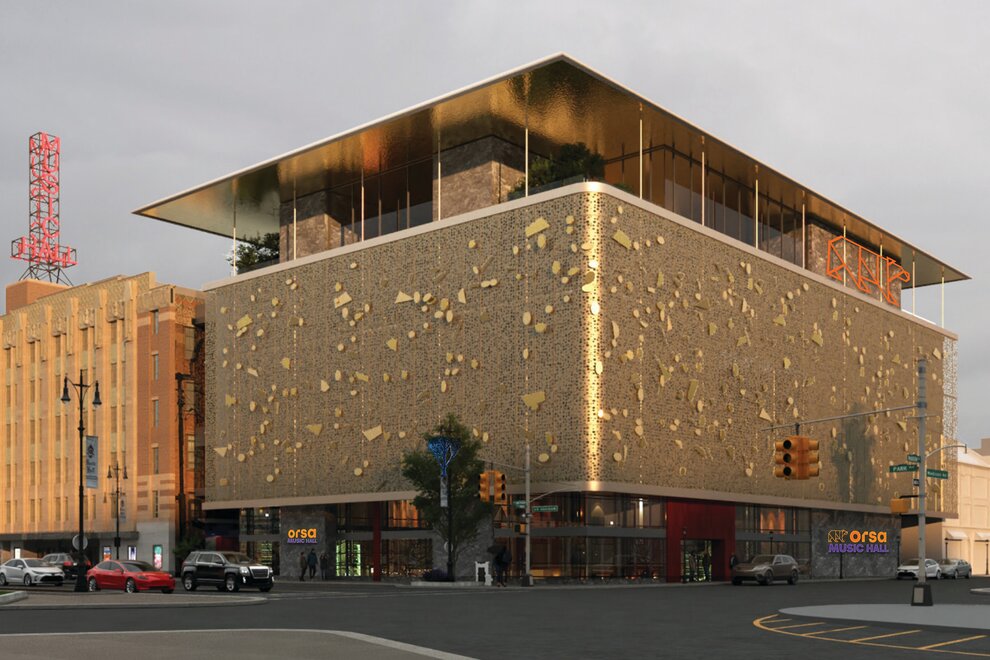
Now, a $20 million, 25-year investment by orsa, formerly Community Financial Credit Union, will help solidify the Music Hall and, by default, Paradise Valley's future as a living, breathing downtown neighborhood where history, creativity, economic activity, and community ownership move forward together.
Detroit Music Hall Center for the Performing Arts and orsa credit union announced the long-term partnership Wednesday, Jan. 28, launching what will become orsa Music Hall, a major expansion of the nearly century-old institution.
With groundbreaking planned for spring 2026, the project is expected to add new performance spaces, classrooms, rehearsal rooms, and community gathering areas, which will bring increased foot traffic, educational opportunities, and sustained investment to one of Detroit's most historically significant corridors.
Dennis Archer Jr. is a longtime Paradise Valley stakeholder, president of the Paradise Valley Conservancy, and President and CEO of Sixteen42 Ventures, located in the neighborhood. For him, the significance of this investment is both symbolic and practical.
"One of the true stalwarts in Paradise Valley over the last 20-plus years has been the Music Hall," Archer said. 'They've been a phenomenal anchor to the neighborhood. To see them now with a very significant expansion, backed by a corporate partner, reinforces Paradise Valley as a cultural hub, just as it was almost a century ago."
Archer framed the expansion as a continuation of the neighborhood's original purpose, particularly for African Americans migrating North who were once barred from many downtown spaces.
That history is now being continued and magnified," he said. "With another theater, classrooms, recording studios - all of it under one roof - it triples down on the legacy of the neighborhood. And the traffic this will generate is going to be great for businesses, property owners, and everyone invested in Paradise Valley's future."
At the center of that momentum is Detroit Music Hall, which opened in 1928 and now hosts more than 300 events annually while reaching roughly 5,000 K-12 Detroit students each year through arts education. Over the decades, its stages have welcomed artists ranging from Count Basie and Eartha Kitt to Aretha Franklin, while continuing to evolve with contemporary, local, youth, and family-focused programming.
Vince Paul, president and artistic director of Music Hall, said the expansion is intentionally designed to deepen that role as an engine for access, learning, and belonging. "Music Hall has always been about more than performance," Paul said. "It's about building community, sharing stories, and creating space where people feel connected. This partnership allows us to do that at a much greater scale, while staying rooted in the values and history of Paradise Valley."
Paul emphasized that the project is as much about people as it is about buildings.
"We're creating pathways," he said. "From rehearsal rooms to the spotlight. From classrooms to careers. From first exposure to lifelong engagement with the arts. This expansion gives us the resources to meet artists and students where they are and grow with them over time."
The partnership arrives as Music Hall approaches its 100th anniversary, a milestone Paul views as both a reflection point and a call to action.
"Reaching a century is not about looking backward;' he said. "It's about asking what responsibility we have to the next 100 years. This investment allows us to widen access, strengthen Detroit's role as a global music city, and ensure that Paradise Valley remains a place where creativity thrives."
Alex Parrish, chairman of the Music Hall board, said the development represents a long-term commitment to both institutional sustainability and neighborhood vitality.
"This expansion ensures that Music Hall can continue serving Detroit for generations," Parrish said. "But just as importantly, it reinforces our role within Paradise Valley. We are part of an ecosystem here, and when Music Hall grows responsibly, the neighborhood grows with it. I see the orsa Music Hall as the gateway to the Valley, and it will continue to be just that and much more as this project evolves."
Parrish noted that the project sends a broader message about confidence in the area. "It signals that Paradise Valley is a place of present-day investment and future opportunity, where culture, education, and economic activity intersect." That message is amplified by orsa credit union, which announced the partnership as it steps forward under a new name and expanded vision.
"As we introduce orsa, this 25-year commitment reflects who we've always been," said Tansley Stearns, president and CEO of orsa credit union. "We are a cooperative that shows up for communities and invests in what helps people thrive. The arts do exactly that." Stearns described the partnership as rooted in shared values rather than branding alone.
"orsa Music Hall is about joy, belonging, and long-term belief in Detroit and in the people who create its future," she said. "We see music and culture as essential infrastructure, and we're proud to support a space where creativity can be explored, nurtured, and celebrated across generations." The partnership builds on orsa's growing footprint in Detroit, including the opening of a full-service branch on Grand River Avenue in Old Redford and continued investments through the orsa foundation in housing stability, financial well-being, and community resilience. orsa has also maintained longstanding relationships with local artists, bringing creative expression into everyday spaces.
For Archer Jr., the partnership with a major financial institution committing long-term resources to Paradise Valley carries particular weight. "When you see a significant financial institution partnering with a significant cultural venue in this neighborhood, it speaks volumes;' he said. "It tells the corporate community that Paradise Valley is viable, that it's worth investing in, and that it has momentum."
He pointed to years of intentional redevelopment efforts, including the work of the Paradise Valley Conservancy, as laying the groundwork for investments like this one. "All of this activity shows that Music Hall is not sitting as an island," Archer said. "It's part of a constantly evolving neighborhood - and that matters." Speaking as both a Detroit resident and a father, Archer said the expansion resonates beyond economics. "For so many years, Paradise Valley and Black Bottom were erased," he said. "What excites me now is that continued investment - especially with strong Black ownership and stewardship - helps ensure that kind of erasure doesn't happen again." 'This is about longevity," he added. "Creating something that endures across generations."
As plans move toward groundbreaking, Paul says the vision remains clear. "This is about honoring where we've been while building what's next," he said. "Paradise Valley has always been a place of resilience and creativity. With this partnership, we're making sure it continues to be a place where Detroit's future is shaped and not just remembered."